
Aesthetics in Your Fifties
By this decade the limiting factor has moved. In your thirties and forties, the thing most worth treating is usually movement: lines being folded in by muscles that won't stop. By your fifties, the canvas itself has changed, and treatments aimed only at movement start delivering less.
That's not a gloomy observation. It's a planning one, and it points at a different and often more satisfying set of choices.
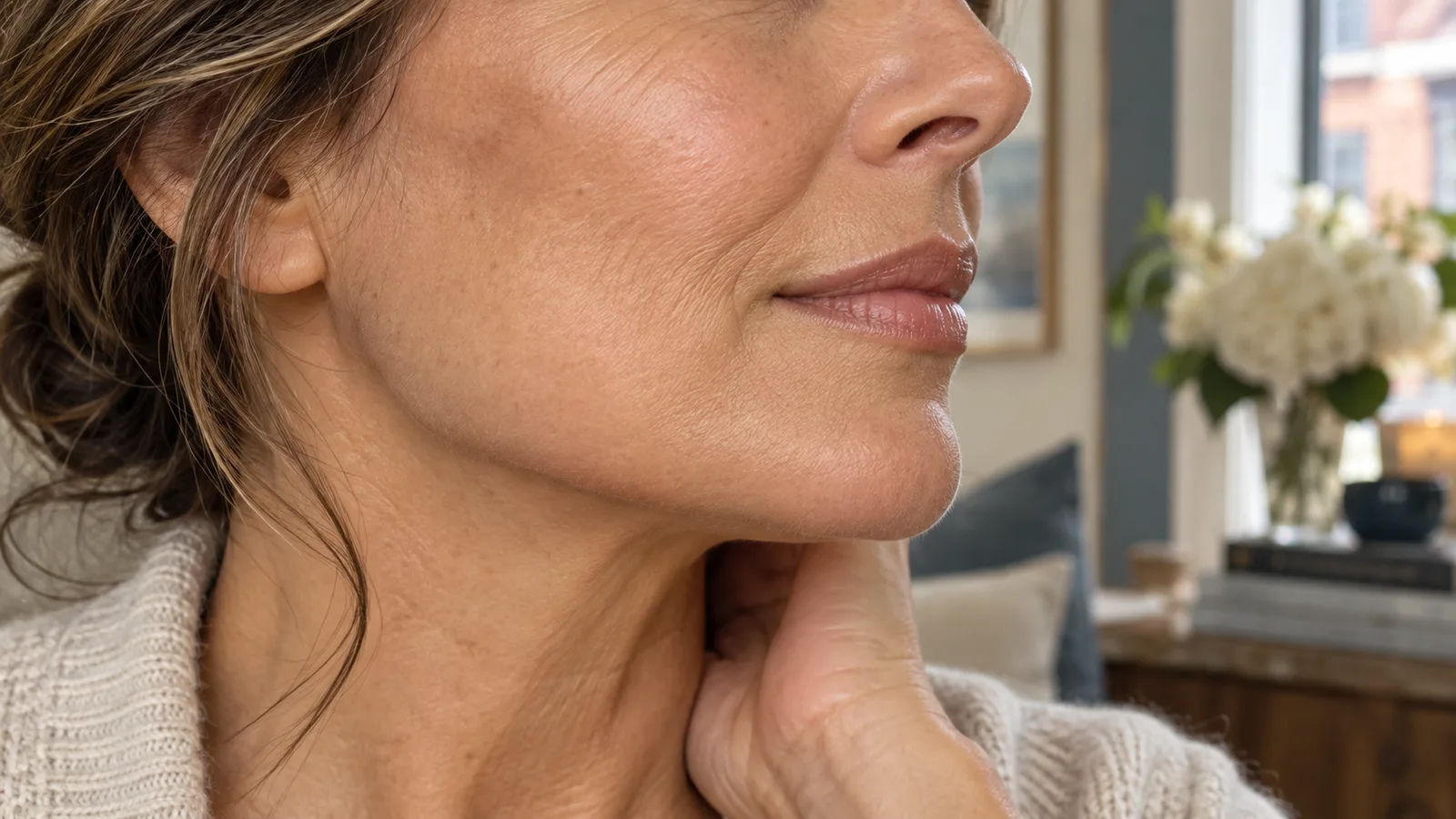
What's different about the canvas
Three changes dominate.
Collagen and elastin have declined, and for women the drop around menopause is steep rather than gradual. Skin gets thinner, drier and slower to recover. It also holds a crease more readily, which is why lines that used to spring back now stay.
Support has been lost underneath. Fat pads have deflated and descended, ligaments have slackened, and bone has resorbed a little. The face reads as heavier at the bottom and emptier at the top, which is the opposite of how it started.
Pigment has accumulated. Decades of sun show up as unevenness, and uneven tone reads as age at least as strongly as any line does.
Why the plan changes
If you only treat muscle in this decade, you'll be disappointed. A neuromodulator still softens the lines that come from movement, but it can't improve thin, dull skin, and used heavily on an already-lax face it can leave things looking heavy rather than rested.
The better balance is usually a smaller amount of muscle work than you might expect, combined with real attention to skin quality and structural support.
Skin quality means the things that provoke rebuilding: microneedling in a series, peels chosen at a depth your skin can tolerate, PRP facials as an adjunct, and a home routine with a retinoid in it if your skin tolerates one. These are slower, less dramatic and cumulative, and over two years they do more than anything else on the list.
Structural support means filler used as scaffolding rather than volume, deep, conservative, and placed where support has actually gone. There's a threshold worth knowing: past a certain degree of laxity, adding weight to a loose structure drags it down. A provider who tells you that you've reached that point, and that surgery is the honest answer if the sagging is what bothers you, has done you a favour.
The neck, the hands and the rest
This is the decade when the face-only approach starts to look odd. The neck, the chest and the backs of the hands all show sun history and thinning, and they're the areas people forget until a photograph reminds them.
They're also slower to treat and easier to overtreat. Neck skin is thin and unforgiving; hands need a light touch. Go gently and involve someone experienced with those areas specifically.
Most of the everyday gain here is unbillable, though. Sun protection on the neck and hands every day. Enough sleep. Not smoking. It's dull, it's free, and it beats a great deal of what's on the menu.
Expectations, honestly
You can look rested, even-toned and like yourself on a good day. That is achievable and worth having.
You cannot look thirty, and any provider implying otherwise is either inexperienced or selling. The people who look best in this decade are generally the ones who treated conservatively and consistently rather than the ones who did the most.
There's also a timing reality: everything works more slowly now. Collagen treatments that showed results in three months at forty may need six. Build that into the plan instead of reading it as failure and escalating.
Practical things that matter more now
Medication review. More of us are on something by this decade, and blood thinners, immune-modulating drugs and hormone therapy all matter to this work. Bring an actual list.
Bone and skin health. Whatever supports general health here also supports the face. Protein, resistance training, sleep.
Consistency over intensity. Two well-judged appointments a year, held to, beat an ambitious burst followed by eighteen months of nothing.
A longer review cycle. Judge results at six and twelve months, not at four weeks.
A local note on keeping it up
The plans that survive in this town are the ones that fit the geography. If a practice is a walk away, the two-week check happens. If it involves a train and a transfer, it quietly doesn't, and a treatment without its review is a treatment half done. That's why I'd look close to home first, at a clinic offering Hoboken skin treatments, before anything across the river.
The same logic applies to the free half of the plan. Walking here is easy and the Parks and Recreation facilities make it easier still, which is good for your skin in every way except the sun exposure, so a hat and daily SPF are part of the treatment plan whether or not anyone bills you for them. If you want somewhere quiet to actually read up before deciding, the Locations & Hours of Our Branches - Hoboken Public Library page will point you at the nearest branch, and the Stevens Institute of Technology end of town is a pleasant enough walk to think on the way back.
Where I'd start
If you've done nothing so far: begin with skin quality for six months and add nothing else. Establish a baseline, take a photograph in flat light, and see what a consistent routine plus one sensible in-office series gives you.
If you've been treating muscle for years and feel like it's stopped working: it probably hasn't stopped working, it's just no longer the main variable. Ask about skin and support before adding more units.
And if what actually bothers you is laxity along the jaw, ask directly whether any of this addresses it. Sometimes the useful answer is no, and hearing that early saves a great deal of money.