
How Botox Softens Forehead Lines
Your forehead has essentially one muscle doing the lifting. It's called the frontalis, it runs as a broad sheet from your brows up toward your hairline, and it is the reason your eyebrows go up when you're surprised, listening, or reading something on a screen you don't quite believe.
Every time it contracts, the skin over it has to shorten. It buckles into horizontal folds. Do that a few hundred thousand times over a couple of decades and the buckling stops fully releasing.
That's the whole story. The lines aren't a skin problem. They're a folding problem, and the fold comes from underneath.
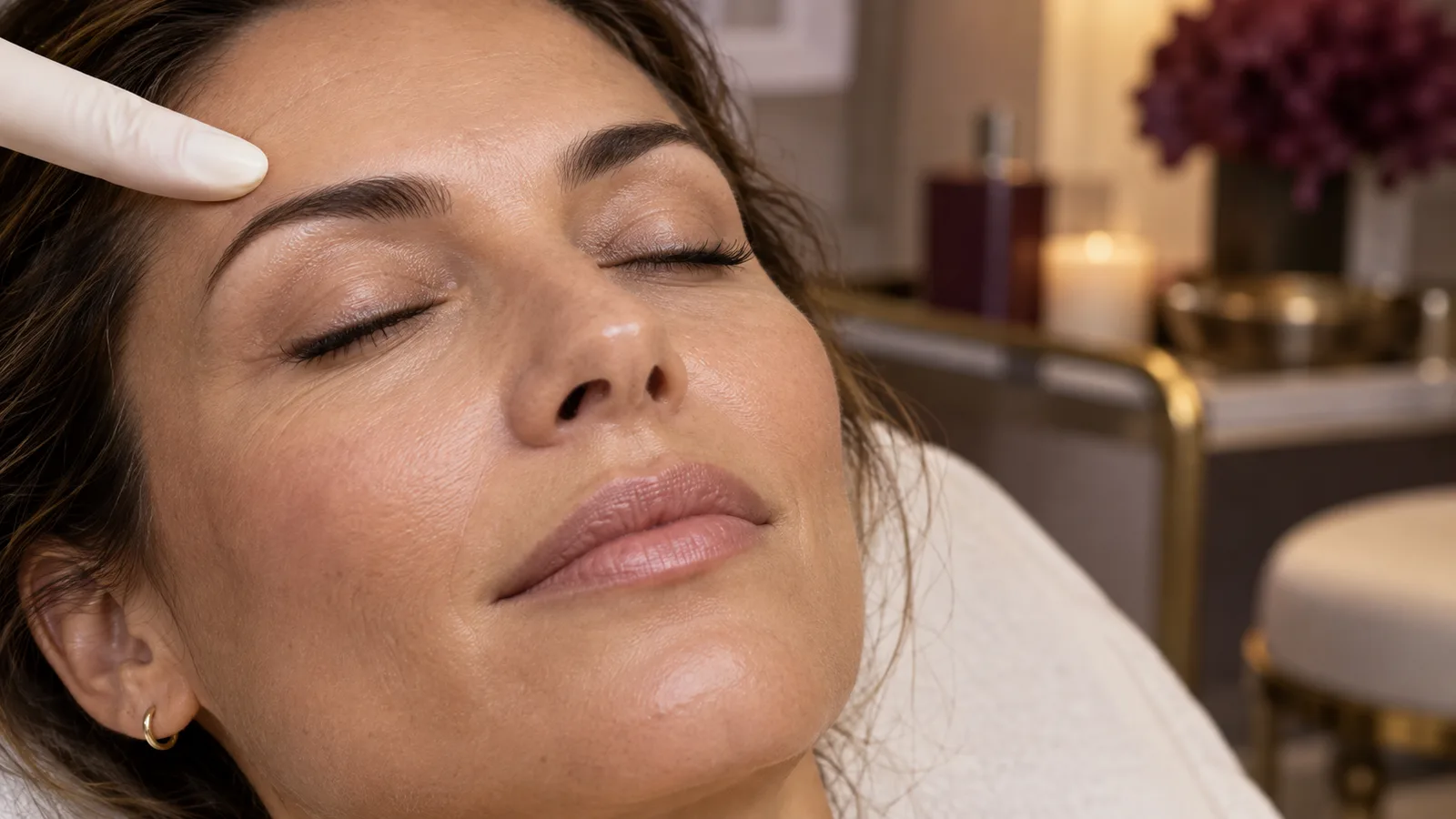
What the injection actually interrupts
A neuromodulator, the Botox family of products, blocks the chemical signal that travels from nerve to muscle. The nerve still fires. The muscle just doesn't receive the instruction, so it contracts less forcefully.
Less contraction means less folding. Less folding gives the skin above a chance to lie flatter, and over the months it's relaxed, some of the settled crease can soften as the tissue is left alone.
It isn't filling the line. It isn't tightening anything. It's taking the pressure off.
Why nothing happens for days
People walk out disappointed, checking a mirror in the lift. Nothing is going to be there.
Blocking that signal isn't instant chemistry. The compound has to be taken up at the nerve ending and interfere with the machinery that releases the messenger. That takes time. Most people notice something around day three or four, see clear change by the end of the first week, and reach the full effect somewhere near two weeks.
This is exactly why the two-week appointment exists, and why it's the most-skipped appointment in aesthetics. At two weeks, the result is honest. Anything looking uneven can be balanced with a small addition, which is a minor adjustment then and a much bigger conversation later.
Booking anything important inside that fortnight is a mistake. Give yourself three weeks of margin before a photographed event.
Why a deep line doesn't vanish
Two lines can sit on the same forehead and behave completely differently.
A dynamic line appears when you lift your brows and disappears when your face is still. These respond well, often dramatically.
A static line is visible when your face is completely at rest. That crease has been folded so consistently that the collagen underneath has reorganised around it. Relaxing the muscle stops it deepening and softens it somewhat, but the groove itself is a structural change and the injection doesn't address structure.
An honest provider will tell you which of yours are which, and will say that the static ones will improve rather than disappear. If they need more than softening, that's a different conversation involving resurfacing, collagen stimulation or filler, with a different cost and a different timeline.
Dose, placement and the frozen look
The frozen forehead people fear is rarely a product problem. It's a mapping problem.
Your frontalis is the only muscle lifting your brows. Relax all of it, everywhere, and your brows can't lift, which is why over-treated foreheads look strangely static and occasionally heavy. Skilled treatment leaves some movement deliberately, particularly toward the outer edges, so your face still does what faces do.
There's a second complication. The muscles between your brows pull down; the frontalis pulls up. Treat the forehead without accounting for the downward group and the balance can shift unhelpfully. This is why providers often treat the two areas together, and why "just my forehead lines, please" isn't always the right instruction to give.
Dose varies by person, not by price list. A strong muscle needs more; a low brow needs a more cautious hand. Anyone quoting you a standard number before looking at your face is quoting the average rather than you.
How long it lasts, and what happens at the end
Three to four months is the usual range. Some people reliably get longer; some metabolise it faster, and exercise volume seems to shorten it for a lot of people.
It wears off gradually. The muscle regains function, movement returns, and your lines come back to roughly where they were. Nothing gets worse from stopping, and nothing is damaged if you never go again. The claim that stopping accelerates ageing is marketing, not biology.
There's one useful thing that does accumulate: if a muscle is habitually less active for a couple of years, some people find they need slightly less over time.
The part that isn't the injection
It's a few minutes with a very fine needle. Most people describe it as a series of small stings. Tiny raised bumps settle within an hour. Bruising is possible, more likely if you've taken anything blood-thinning recently, so mention that beforehand.
The aftercare is simple: stay upright for a few hours, skip the workout that day, and don't massage the area. That's most of it.
Then wait. February is quietly a good month to start this, because your face spends less time being photographed outdoors and there's no event pressure; a glance at the 7-Day Forecast 40.74N 74.04W is enough to avoid booking the day before a heatwave, since flushing and swelling both read worse in heat.
What to do with all this
Go in able to say whether your lines are there at rest or only in motion. Ask what the provider is treating and why. Ask what they're deliberately leaving alone. And book the two-week check before you leave the building.
If you're weighing up practices around here, the Hoboken NJ Website and the City Council listings are a slow but public way to see which businesses are actually established in town rather than newly arrived and heavily advertised.
One established practice for forehead treatment here is Ethos Hoboken, and its Botox page is a sensible place to read up before asking about that review.